EPISTLE I: TO ALL THE OVERSEERS OF SICILY
[Of the final decision of the trials of overseers, and graver ecclesiastical cases in the seat of the apostles.]
Zephyrinus, chief-overseer of the city of Rome, to all the overseers settled in Sicily, in the Lord, greetings.
We ought to be mindful of the grace of God to us, which in His own merciful regard has raised us for this purpose to the summit of priestly honor, that, abiding by His commandments, and appointed in a certain supervision of His priests, we may prohibit things unlawful, and teach those that are to be followed. As night does not extinguish the stars of heaven, so the unrighteousness of the world does not blind the minds of the faithful that hold by the sure support of Writing. Therefore, we ought to consider well and attend carefully to the Writings, and the divine precepts which are contained in these Writings, in order that we may show ourselves not transgressors, but fulfillers of the law of God.
Now patriarchs and primates, in investigating the case of an accused overseer, should not pronounce a final decision until, supported by the authority of the apostles, they find that the person either confesses himself guilty, or is proved so by witnesses trustworthy and regularly examined, who should not be fewer in number than were those disciples whom the Lord directed to be chosen for the help of the apostles—that is, seventy-two. Detractors also, who are to be rooted out by divine authority, and the advisers of enemies (auctores inimicorum), we do not admit in the indictment of overseers or in evidence against them; nor should any one of superior rank be indicted or condemned on the accusations of inferiors. Nor in a doubtful case should a decisive judgment be pronounced; nor should any trial be held valid unless it has been conducted according to order. No one, moreover, should be judged in his absence, because both divine and human laws forbid that. The accusers of those persons should also be free of all suspicion, because the Lord has chosen that His pillars should stand firm, and not be shaken by anyone who will. For a sentence should not bind any of them if it is not given by their proper judge, because even the laws of the world ordain that that be done. For any accused overseer may, if it be necessary, choose twelve judges by whom his case may be justly judged. Nor should he be heard or excommunicated or judged until these be chosen by him; and on his being regularly summoned at first to a council of his own overseers, his case should be justly heard by them, and investigated on sound principles. The end of his case, however, should be remitted to the seat of the apostles, that it may be finally decided there. Nor should it be finished, as has been decreed of old by the apostles or their successors, until it is sustained by its authority. To it also all, and especially the oppressed, should appeal and have recourse as to a mother, that they may be nourished by her breasts, defended by her authority, and relieved of their oppressions, because “a mother cannot,” and should not, “forget her son.” For the trials of overseers and graver ecclesiastical cases, as the apostles and their holy successors have decreed, are to be finally decided along with other overseers by the seat of the apostles, and by no other; because, although they may be transferred to other overseers, it was yet to the blessed Apostle Peter these terms were addressed: “Whatsoever you will bind on earth will be bound in heaven, and whatsoever you will loose on earth will be loosed in heaven.” And the other privileges which have been granted to this holy seat alone are found embodied both in the constitutions of the apostles and their successors, and in very many others in harmony with these. For the apostles have prefixed seventy decrees, together with very many other overseers, and have appointed them to be kept. For to judge rashly of the secrets of another’s heart is sin; and it is unjust to reprove him on suspicion whose works seem not other than good, since God alone is Judge of those things which are unknown to men. He, however, “knows the secrets of the heart,” and not another. For unjust judgments are to be guarded against by all, especially however by the servants of God. “And the servant of the Lord must not strive,” nor harm any one. For overseers are to be borne by laity and clergy, and masters by servants, in order that, under the exercise of endurance, things temporal may be maintained, and things eternal hoped for. For that increases the worth of virtue, which does not violate the purpose of religion. You should be earnestly intent that none of your brothers be grievously injured or undone. Therefore, you ought to aid the oppressed, and deliver them from the hand of their persecutors, in order that with the blessed Job you may say: “The blessing of him that was ready to perish will come on me, and I consoled the widow’s heart. I put on righteousness, and clothed myself with a robe and a diadem, my judgment. I was eye to the blind, and foot to the lame. I was a father to the poor, and the cause which I did not know I searched out most carefully. I brake the grinders of the wicked, and plucked the spoil out of his teeth”; and so forth. You, therefore, who have been placed in eminence by God, ought with all your power to check and repel those who prepare snares for brothers, or raise seditions and offenses against them. For it is easy by word to deceive man, not however God. Therefore, you ought to keep these off, and be on your guard against them, until such darkness is done away utterly, and the morning star shines on them, and gladness arises, most holy brothers. Given on the 20th September, in the consulship of the most illustrious Saturninus and Gallicanus.
EPISTLE II: TO THE OVERSEERS OF THE PROVINCE OF EGYPT
PREFACE
Zephyrinus, chief-overseer of the city of Rome, to the most beloved brothers who serve the Lord in Egypt.
Such great trust have we received from the Lord, the Founder of this holy seat and of the apostolic assembly, and from the blessed Peter, chief of the apostles, that we may labor with unwearied affection for the Universal Assembly which has been redeemed by the blood of Christ, and aid all who serve the Lord, and give help to all who live piously by apostolic authority. All who will live piously in Christ must necessarily endure reproaches from the impious and aliens, and be despised as fools and madmen, that they may be made better and purer who lose the good things of time that they may gain those of eternity. But the contempt and ridicule of those who afflict and scorn them will be cast back on themselves, when their abundance will change to want, and their pride to confusion.
CHAPTER 1: On the Spoliation or Expulsion of certain Overseers
It has been reported at the seat of the apostles by your delegates, that certain of our brothers, overseers namely, are being expelled from their assemblies and seats, and deprived of their goods, and summoned, thus destitute and spoiled, to trial; a thing which is void of all reason, since the constitutions of the apostles and their successors, and the statutes of emperors, and the regulations of laws, prohibit it, and the authority of the seat of the apostles forbids it to be done. It has been ordained, indeed, in the ancient statutes, that overseers who have been ejected and spoiled of their property should recover their assemblies, and, in the first place, have all their property restored to them; and then, in the second place, that if any one may desire to accuse them justly, he should do so at the like risk; that the judges should be discreet, the overseers right-minded and harmonious in the Assembly, where they should be witnesses for everyone who seemed to be oppressed; and that they should not answer until all that belonged to them was restored to them, and to their assemblies by law without detriment. Nor is it strange, brothers, if they persecute you, when they persecuted even to death your Head, Christ our Lord. Yet even persecutions are to be endured patiently, that you may be known to be His disciples, for whom also you suffer. Whence, too, he says Himself, “Blessed are they which are persecuted for righteousness’ sake.” Sustained by these testimonies, we ought not greatly to fear the reproach of men, nor be overcome by their rebukes, since the Lord gives us this command by Isaiah the prophet, saying, “Listen to me, you that know righteousness, my people, in whose heart is my law; do not fear the reproach of men, neither be afraid of their revilings”; considering what is written in the Psalm, “Will not God search this out? for He knows the secrets of the heart, and the thoughts of such men, that they are vanity,” “They spoke vanity every one with his neighbor: with deceitful lips in their heart, and with an evil heart they spoke. But the Lord will cut off all deceitful lips, and the tongue that speaks proud things; who have said, Our lips are our own; who is Lord over us?” For if they kept these things in memory, they would by no means break forth into so great wickedness. For they do not this by laudable and paternal instruction (probabili et paterna doctrina), but that they may wreak their vengeful feeling against the servants of God. For it is written, “The way of a fool is right in his eyes”; and, “There are ways which seem right to a man, but the end thereof leads to death.” Now we who suffer these things ought to leave them to the judgment of God, who will render to every man according to his works; who also has thundered through His servants, saying, “Vengeance is mine, I will repay.” Assist you, therefore, one another in good faith, and by deed and with a hearty will; nor let anyone remove his hand from the help of a brother, since “by this,” says the Lord, “will all men know that you are my disciples, if you have love for one another.” Whence, too, He speaks by the prophet, saying, “Behold how good and how pleasant it is for brothers to dwell together in unity!” In a spiritual dwelling, I interpret it, and in a concord which is in God, and in the unity of the faith which distinguishes this pleasant dwelling according to truth, which indeed was more beauteously illustrated in Aaron and the priests clothed with honor, as ointment on the head, nurturing the highest understanding and leading even to the end of wisdom. For in this dwelling the Lord has promised blessing and eternal life. Apprehending, therefore, the importance of this utterance of the prophet, we have spoken this present brotherly word for love’s sake, and by no means seeking, or meaning to seek, our own things. For it is not good to repay detraction with detraction, or according to the common proverb to cast out a beam with a beam (excutere palum palo). Be it far from us. Such manners are not ours. May the Godhead indeed forbid it. By the just judgment of God, power is given sometimes to sinners to persecute His holy ones, in order that they who are aided and borne on by the Spirit of God may become more glorious through the discipline of sufferings. But to those very persons who persecute, and reproach, and injure them, there will doubtless be woe. Woe, woe to those who injure the servants of God; for injury done to them concerns Him whose service they discharge, and whose function they execute. But we pray that a door of enclosure be placed on their mouths, as we desire that no one perish or be defiled by their lips, and that they think or publish with their mouth no hurtful word. Whence also the Lord speaks by the prophet, “I said I will take heed to my ways, so that I do not sin with my tongue.” May the Lord Almighty, and His only-begotten Son and our Savior Jesus Christ, give you this incitement, that with all means in your power you aid all the brothers under whatsoever tribulations they labor, and esteem, as is meet, their sufferings your own. Afford them the utmost assistance by word and deed, that you may be found His true disciples, who enjoined all to love the brothers as themselves.
CHAPTER 2: On the Ordination of Elders and Ministers
Ordinations of elders and Levites, moreover, solemnly perform on a suitable occasion, and in the presence of many witnesses; and to this duty advance tried and learned men, that you may be greatly gladdened by their fellowship and help. Place the confidence of your hearts without ceasing on the goodness of God, and declare these and the other divine words to succeeding generations: “For this is our God forever and ever, and He will guide us to eternity.” Given on the 7th November, in the consulship of the most illustrious Saturninus and Gallicanus.
ABOUT THE BIBLE
The Bible is a written record of God’s revelations to mankind. As originally transcribed by the Spirit-led men who recorded these revelations, it is completely inerrant—a perfect record of history, science, and spiritual truth. The theme of the Bible regards the fall of human beings into spiritual death in the Garden of Eden and God’s plan to redeem them through a substitutionary sacrifice. This promised “Seed,” born of woman, would crush the head of the serpent—the Devil—and free those who trust in God from death and the penalty and power of sin. In the Hebrew Bible, which Christians call the Old Testament, the Seed is prophesied to be the Messiah, or “Anointed One” of God, who would inherit the throne of His ancestor David and save believers from their sins. In the Greek portion of the Bible, called the New Testament, the Messiah is revealed to be God’s only begotten Son, the Lord Jesus Christ. Jesus the Messiah lived a sinless life and took upon Himself the sins of all on the Cross. He was crucified, buried in a tomb, and on the third day He came back to life. Hundreds of His disciples witnessed Him risen from the dead and many went on to give their lives in martyrdom, testifying to the truth of forgiveness of sins in Christ alone, and the promise that all who trust in Him will be resurrected to inherit eternal life in union with God. In accordance with the Scriptures, the Lord Jesus will return to earth one day to restore the Kingdom to Israel and to reign over all the nations of the world. Preceding this event, believers are promised to be transformed into immortal bodies, being taken to Heaven to escape the coming wrath.
|
Languages of the Bible:
|
Hebrew, Aramaic, and Greek
|
Most of the Old Testament was originally composed in Hebrew, although some scholars argue a nearly equal portion was composed in Aramaic. At minimum, large portions of Daniel and Ezra were written in Aramaic. It is thought that all of the New Testament was written in Greek with strong Hebrew and Aramaic influences.
|
|
Dates of composition:
|
Circa 15th century BC through the end of the 1st century AD
|
It is traditionally thought that Moses transcribed the first five books, called the Torah or Pentateuch. The Apostle John is believed to be the author of some of the latest books of the New Testament, including the Gospel of John and Revelation, which were written toward the end of the 1st century.
|
|
Number of books:
|
66
|
There have been varying schools of thought as to what constitutes the full canon of Scripture, but among Christian scholars there is widespread consensus that the 66 books found in most versions constitute the unquestionable Protocanon. Other books, called the Deuterocanon, are sometimes included.
|
LANGUAGES OF THE BIBLE
HEBREW: The language of most of the Old Testament, Hebrew is a Northwest Semitic language and a regional dialect of the Canaanite languages. It was natively spoken by the ancient Israelites and remained in regular use as a first language until after AD 200 and as the liturgical language of Judaism and Samaritanism. Hebrew was revived as a spoken language in the 19th century and is the only successful largescale example of linguistic revival. It is the only Canaanite language still spoken today, and in 2018, Hebrew became the official language of Israel. The original Hebrew writings were recorded in Paleo-Hebrew, a script almost indistinguishable from Phoenician and other regional Canaanite dialects. It was slowly replaced with the better-known square script, derived from Aramaic, but found some continued usage in Judea even into the 1st century BC. A variation still lives on among the Samaritans and is found in the Samaritan Pentateuch.
By the 5th century BC, Paleo-Hebrew script was largely replaced with the Aramaic alphabet, which evolved in the Hebrew context to eventually become the well-known square Hebrew script of the Masoretic Text of the Bible and Modern Hebrew (shown below).
|
כ / ך
Kaf
(20)
|
י
Yod
(10)
|
ט
Tet
(9)
|
ח
Chet
(8)
|
ז
Zayin
(7)
|
ו
Waw
(6)
|
I ה
He
(5)
|
ד
Dalet
(4)
|
ג
Gimel
(3)
|
ב
Beyt
(2)
|
א
Alef
(1)
|
|
ת
Taw
(400)
|
ש
Shin
(300)
|
ר
Resh
(200)
|
ק
Qof
(100)
|
צ / ץ
Tsade
(90)
|
פ / ף
Pe
(80)
|
ע
Ayin
(70)
|
ס
Samekh
(60)
|
נ / ן
Nun
(50)
|
מ / ם
Mem
(40)
|
ל
Lamed
(30)
|
ARAMAIC: Aramaic is a Northwest Semitic language, closely related to Hebrew, that originated in the ancient region of Syria and quickly spread to Mesopotamia, the southern Levant, southeastern Anatolia, eastern Arabia, and the Sinai Peninsula, where it has been continually written and spoken in different varieties for over 3,000 years. Small portions of the Old Testament (primarily in Daniel and Ezra) were written in Imperial Aramaic; however, the Masoretic Text of the Hebrew Bible utilizes the square Hebrew script, even in these Aramaic passages.
GREEK: Greek is an Indo-European language, constituting an independent Hellenic branch within the Indo-European language family. It is native to Greece, Cyprus, Italy (in Calabria and Salento), southern Albania, and other regions of the Balkans, Caucasus, the Black Sea coast, Asia Minor, and the eastern Mediterranean. It has the longest documented history of any Indo-European language, spanning at least 3,400 years of written records. Its writing system is the Greek alphabet, which has been used for approximately 2,800 years. The Old Testament was translated from Hebrew to Greek in the 3rd and 2nd centuries BC, and most or all of the New Testament was originally composed in Koine Greek, the lingua franca of the Mediterranean region and common dialect of Greek written and spoken during the Hellenistic period. Like Hebrew, Greek letters signified numbers, but the numbers 6 and 90 were denoted by the obsolete letters digamma and koppa, respectively.
|
Αα
Alpha
(1)
|
Ββ
Beta
(2)
|
Γγ
Gamma
(3)
|
Δδ
Delta
(4)
|
Εε
Epsilon
(5)
|
Ζζ
Zeta
(7)
|
Ηη
Eta
(8)
|
Θθ
Theta
(9)
|
Ιι
Iota
(10)
|
Κκ
Kappa
(20)
|
Λλ
Lambda
(30)
|
Μμ
Mu
(40)
|
|
Νν
Nu
(50)
|
Ξξ
Xi
(60)
|
Οο
Omicron
(70)
|
Ππ
Pi
(80)
|
Ρρ
Rho
(100)
|
Σσς
Sigma
(200)
|
Ττ
Tau
(300)
|
Υυ
Upsilon
(400)
|
Φφ
Phi
(500)
|
Χχ
Chi
(600)
|
Ψψ
Psi
(700)
|
Ωω
Omega
(800)
|
BEFORE THERE WAS TIME
Why do things exist? Where did the universe come from? Is it just part of an endless cycle of compressions and expansions, without real cause or origin? Did it simply appear out of the void of nothingness? Is it merely one of a virtually infinite number of universes bubbling out of an all-encompassing multiverse as posited by many string theorists? And what, if anything, existed before the universe came into being?
Mankind has developed a myriad of theories regarding origins and who or what existed before time—if “before” can even be used to describe a time without time.
According to the Bible, it is God who existed before the creation of the world:
“Before mountains were brought forth, || And You form the earth and the world, || Even from age to age You [are] God.” (Ps. 90:2, LSV)
And He Himself was created by no one:
“You [are] My witnesses, a declaration of Jehovah, || And My servant whom I have chosen, || So that you know and give credence to Me, || And understand that I [am] He, || Before Me there was no God formed, || And after Me there is none.” (Isa. 43:10)
And again:
“Thus said Jehovah, King of Israel, || And his Redeemer, Jehovah of Hosts: ‘I [am] the first, and I [am] the last, || And besides Me there is no God.’” (Isa. 44:6)
THE UNMOVED MOVER
We can plainly see that things exist, and things cannot come from true nothingness. There must be something (or someone) that brought visible and invisible things into existence. This is what we call the cosmological argument. The original and ultimate cause of all things must necessarily be transcendent and self-existent or else it would itself have been created and there would be an eternal procession of created things causing created things, which is a logical impossibility.
This bedrock truth of an “unmoved mover”—as Aristotle coined it—has been one of the fundamentals of philosophy, in one form or another, throughout all of human history and was promulgated not only by Judeo-Christianity and the Abrahamic traditions, but also by the ancient Greeks, Romans, and Arabs, and is even acceded to by modern scientific philosophers who posit the existence of an eternal, self-existent, all-encompassing dimension that might have given rise to our universe. Secular philosophers acknowledge the logical necessity for there to be something that is itself uncreated and ungenerated, and that this self-existent entity contains all possible information, energy, and dimension. Whether they call it “the Multiverse,” “the 11th Dimension,” “the 26th Dimension,” or some other permutation thereof, the secular mind still chooses to regard it as unintelligent and unaware, but that is folly. The “unmoved mover” has the same attributes as the God of the Bible, but these attributes are often described using terminology more at home in metaphysics than in theology (e.g., unlimited energy vs. omnipotence; all possible information vs. omniscience; boundless infinity vs. omnipresence).
OTHER LOGICAL ARGUMENTS FOR GOD
The Ontological Argument: God is the greatest conceivable being and it is greater to exist than not to exist, thus God must necessarily exist or else He would not be the greatest conceivable being. In this way, the existence of the supreme, self-existent being can be deduced through reason and intellect alone.
The Teleological Argument: It is beyond improbable for non-life to give rise to life because of the incomprehensible complexity of living things. Considering that the universe appears perfectly and improbably tailored for the existence of life, there must necessarily be a super-intelligence that created the universe with the perfect parameters for life who then created incomprehensibly complex lifeforms.
Common rebuttals to this argument simply skirt the issue. For instance, the multiverse hypothesis proposes a virtually infinite number of universes, so that there will eventually be some small fraction that have the right parameters for life, but as explained in the previous section, the all-encompassing dimension would itself be the unmoved mover (“God” by another name). Panspermia, the theory that life was simply seeded on earth via extraterrestrials or inadvertently planted here by hitching a ride on space dust or an asteroid, is simply moving the goalpost. No longer does one have to explain how impossibly-complex life arose on earth—now they have to explain how impossibly-complex life arose somewhere else in the universe.
Abstract Ideas and Truths: We can perceive the universality of spiritual truths such as beauty, morality, and love, and that such things cannot be adequately explained through mere natural mechanisms. The origin of these obvious, yet abstract concepts must be a being who Himself is beautiful, moral, and loving.
In conclusion, all belief systems aside from monotheism, such as atheism, polytheism, and pantheism, disregard these basic and most fundamental truths of common sense and simple logic. Given the logical necessity for the existence of God, the ultimate truth and purpose of life must be found in believing in and worshiping this transcendent God who created all things and who has chosen to reveal Himself to us through means of reason, creation, and spiritual revelation.
WHICH GOD?
Concluding that God must exist, we can discern which God must be followed and believed in. There are many religious texts that claim to reveal the true God and there are many people who have claimed to either be God or to know God, but only one text withstands all scrutiny and only one person’s claim to be God passes muster.
Judeo-Christianity predates every other contemporary religion, beginning in the 20th century BC when Abram heeded God’s call to migrate to Canaan. His monotheistic faith not only set the stage for the Bible to be written, but also for the coming of the Messiah (the Redeemer of mankind). Judaism proper—adherence to the Law of Moses—came about in the 15th century BC when the Israelites escaped Egypt and their earthly leader Moses received God’s instructions (the first five books of the Bible, called the Torah or Pentateuch). All other modern religions developed later: Hinduism circa 1000–500 BC, Zoroastrianism circa 600 BC, Buddhism in the 5th century BC, Taoism in the 4th century BC, and Islam in the 6th or 7th century AD. Judeo-Christianity preceded all of these by at least 500 years.
Some might argue that Christianity was not established until AD 30 to 33 when Jesus of Nazareth was crucified, and, according to His disciples, rose from the dead and subsequently ascended into Heaven. This is why we use the term Judeo-Christianity. The central theme in all of the ancient Hebrew religious texts is the belief in a coming Messiah who would redeem God’s people. This Anointed One (called Christ in Greek or Messiah in Hebrew) would fulfill the Law, Psalms, and Prophets, save the lost, and establish an everlasting Kingdom. The very first prophecy given in the Bible is about Him (Gen. 3:15) and the Old Testament (called the Tanakh in Judaism) is replete with descriptions about Him and what He would do and accomplish (e.g., Deut. 18:14–22; Job 19:25; Ps. 2; Ps. 22; Isa. 9:1–7; Is. 53; Zech. 12:10–14; 14:3–4). The Old Testament is about Christ and His people the Israelites. It is proto-Christianity in the truest sense.
The root of monotheism and religion itself is Judeo-Christianity. Common religious concepts like God, worship, ritual, faith, forgiveness, grace, and redemption all stem from the Bible and the revelations contained therein. All other religions are corrupted and twisted imitations—counterfeits of the original.
In secular circles it is common to speak collectively of books like the Bible, Koran, and Bhagavad Gita as “sacred texts” or “holy books,” but the terms are inaccurate and cause confusion. By very definition the terms equate all truth claims and neglect objectivity. Each of these books contain numerous mutually exclusive tenets and statements that are presented as facts. Not all are true and not all are holy. For example, the Bible repeatedly claims that Yahweh is the only God (e.g., Deut. 4:35, 39; 6:4; 32:39; Isa. 43:10; 44:6, 8; 45:21; 46:9; Mk. 12:29–34; Jn. 17:3; 1 Cor. 8:4–6; Eph. 4:6; 1 Tim. 2:5; Jas. 2:19) and that Jesus is the only source of salvation (e.g., Ps. 2:1–12; Jn. 3:18, 36; 8:24; 14:6; Acts 4:12; 2 Thess. 1:8; 1 Tim. 2:5; 1 Jn. 5:11–13). Allah, Brahma, Zeus, and Ba‘al cannot be gods, and neither can Islam, Hinduism, or the Buddha be paths to salvation if the Bible’s claims are true.
A principal belief of the Judeo-Christian faith presented in the Bible is that reality itself is rooted in the self-existent God (Yahweh/Yehovah, whose Name means “I Am that I Am” or “The One who is, who was, and who is to come”) and only God’s revelations to mankind can be regarded as objective truth. From the very beginning of the Bible, we discover that the book presents the Deity as self-existent, outside of time, transcendent, and personally involved in His creation—both before and after His creative activity. Therefore, the Bible and the Noahic-Abrahamic traditions that preceded it proclaim monotheism to be objective truth. This necessarily rules out pantheism, panentheism, polytheism, animism, and deism—the bulk of all other religions.
But is the Bible’s claim about the Deity correct? The cosmological, teleological, and ontological arguments—and numerous other arguments—are indisputable rationale for the existence of a transcendent, self-existent being. This scholarly and philosophical foundation is unique to monotheism among all other religions and belief systems. God is the simplest, most logical, and most rational explanation for all that we see around us.
“For the invisible things of Him from the creation of the world, by the things made being understood, are plainly seen, both His eternal power and Godhead—to their being inexcusable . . .” (Rm. 1:20)
“You—you have been shown [it], to know that He, Jehovah, [is] God; there is none else besides Him.” (Deut. 4:35)
But how do we know the Bible itself is true? The correct answer is because the Bible is God-breathed. In its original Hebrew, Aramaic, and Greek manuscripts it is inerrant and infallible. The true God spoke true words audibly, and sometimes into the minds, of fallible human beings (cf. 2 Tim. 3:16–17 and 2 Pet. 1:20–21). But, understandably, that answer will not satisfy the skeptic. There are at least six key arguments that powerfully vouch for the Bible’s unique authenticity:
1. Every claim in the Bible that can be demonstrably tested has been verified. In other words, if we presently possess some scientific know-how, archaeological discovery, or corroborating text that can directly test a specific claim from the Bible, the claim has been verified. As a matter of fact, this truth has caused a great deal of consternation for secular historians over the past several decades as discovery after discovery has proven the Bible true even after historians had said “it just can’t be.” Whether it be the fallen walls of Jericho, the reign of King Hezekiah, or even the existence of a Jewish temple, every bit of physical evidence that has turned up to answer the Bible’s claims has proven the Bible true.
2. There are more ancient manuscripts of the Bible than any other ancient text. Furthermore, the discovery of the Dead Sea Scrolls in 1946/47 dealt a significant defeat to the theory of that generation’s textual critics. They had taught that the Old Testament was composed much later than Jews and Christians believed and had undergone a significant evolution in content. Not only did the Dead Sea Scrolls disprove that claim, showing that the Old Testament we have today is equivalent to the one used by Christ and His disciples, but they also provided rock-solid evidence that numerous prophecies about Jesus Christ were written before He was born.
3. The Bible contains self-verifying mathematical and thematic codes underlying the text. In recent years scholars have discovered numerous number patterns in the text in various books, such as Genesis and the synoptic gospels, that would be impossible for humans to have developed on their own. There are similar thematic codes that testify to the Bible’s divine origins.
4. Despite having been written over a period of 1,600 years by 40 different authors, the Bible forms a single metanarrative. The Bible forms a continuous story with a clear beginning, ending, climax, protagonist, antagonist and complex, repeating themes that recur in almost every book. Yet its authors’ lives were separated by many centuries, occurring on three different continents, and in several different ancient cultures. This incredible collection of history, poetry, prophecy, and letters forms a single, overarching story from beginning to end. The protagonist and antagonist show up at the beginning of the story, continue their parts throughout, and reach a climactic moment, culminating with a final showdown—the final battle at the culmination of the ages. Dozens of themes, symbols, and patterns recur through the entire text, from Genesis to Revelation. No other religious text can boast of such miraculous development.
5. The Bible forms a doctrinal hologram. Typical religious texts are one or two-dimensional. If you take out a passage from the text the religious message is fundamentally altered—removing key doctrines. It is like a painting on a canvas—mar a section of the picture and you can no longer see the whole. Strangely, the Bible is different. From a doctrinal perspective it forms something analogous to a three-dimensional hologram. You can remove any piece of a hologram, move to a different viewing angle, and still see the whole. Doctrines revealed in the Bible are spread out across the entire book, like an interconnected web. This is strong evidence that the book’s underlying author intended His message to get through even if someone tampered with the text. This complex web or layering is hinted at in Isaiah 28: “...precept upon precept, line upon line, here a little, there a little.”
6. Prophecy is unique to the Bible and is its watermark of authenticity. Other religious texts contain “prophecy,” but unique to the Bible are very specific prophecies that can be demonstrably proven to have been written before the events occurred. Isaiah 53 is an important example. Written some 700 years before Jesus Christ was born, it correctly prophesied that He would come from humble origins, die as a substitutionary sacrifice for our sins, be buried in a rich man’s tomb, rise to life again, and be glorified. There are hundreds of other such prophecies.
WHO AND WHAT IS GOD?
Through simple deduction we have concluded that God must exist and that the God of the Bible is the true God because His revealed word is uniquely and demonstrably true. But who is He and what has He revealed about Himself?
We know that He is self-existent (Ex. 3:14; Is. 43:10), eternal (Ps. 90:2; Is. 40:28), omnipotent (Lk. 1:37; Mt. 19:26), omniscient (Ps. 147:4–5; Heb. 4:13), omnipresent (Ps. 139:7–10; Eph. 4:10), and unchanging (Mal. 3:6; Heb. 13:8; Jas. 1:17). We also know that He is good (Ps. 34:8; 145:9), His word is infallible (Mt. 5:18; 2 Tim. 3:16), and His nature is love (1 Jn. 4:8). Most importantly, we know that He is One (Deut. 6:4). These characteristics and attributes help us to understand the nature of God, but we need to know Him on a deeper level.
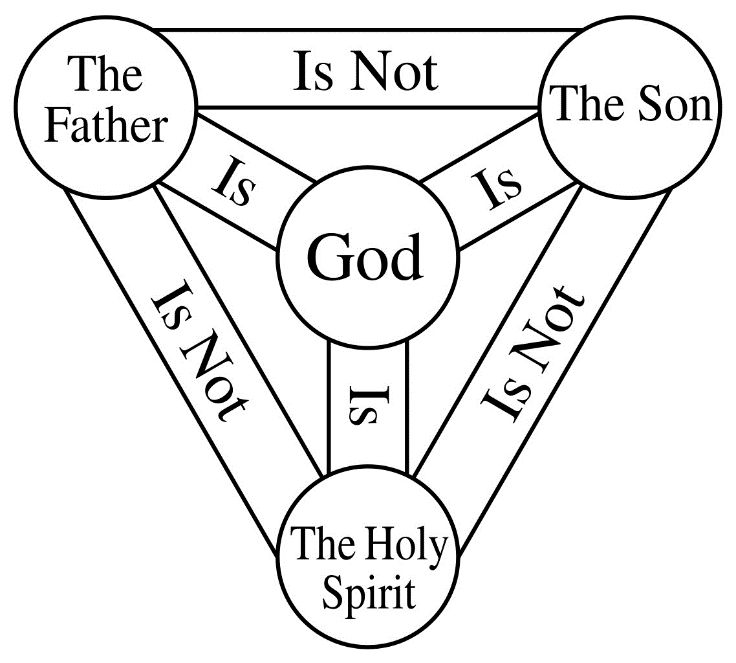
In Scripture we learn that though God is one being, He exists as the mutual indwelling of three divine Persons: The Father, the Son, and the Holy Spirit (Mt. 3:13–17; 28:19; Mk. 1:9–11; Lk. 1:35; 3:21–22; Jn. 1:29–34; 14:26; Acts 1:4–8; 2 Cor. 13:14; Eph. 1:3–17; 1 Pt. 1:2; Rev. 4:3, 5; 5:1–6). God is One and cannot be divided, thus these three Persons are neither parts nor forms (also called modes in theological lingo). They are different and distinguishable in relationship and personality, but not in being or essence.
Praise God, from whom all blessings flow;
Praise Him, all creatures here below;
Praise Him above, ye heav’nly host;
Praise Father, Son, and Holy Ghost!
Intriguingly, it would seem God has left His mark of three-in-one all over the universe. The fundamental universe consists of space, time, and substance (elementary particles of energy and matter), and each of these things is precisely three-in-one:
Space, which gives the universe structure, consists of height, width, and depth. Each dimension is necessary, or space would not exist. If there was no height, then there would be neither width nor depth. And if there was no depth, there would be neither height nor width. Each dimension gives the other two dimensions substance. A single, unitary space consists of exactly three dimensions.
Time, which produces history and change, consists of past, present, and future. Just like space, each aspect is necessary for the others. If there was never a past, then there could not be a present or future. And if there is not a future, then we would be frozen in a three-dimensional picture, like a static hologram. Time consists of a single continuum of exactly three components: past, present, and future.
Matter, which is the tangible structure of the universe, the air we breathe, the water we drink, and the flesh and bones of our bodies, takes the form of a solid, liquid, or gas. Each of the three is distinct, but each remains matter regardless of its form. H2O’s forms of water, ice, and steam are a perfect demonstration of this. Plasma is often described as a fourth fundamental state of matter, although it is always defined as gas, albeit ionized.
There are a great many examples of this concept of three-in-one embedded throughout the created order:
|
Subatomic particles of an atom:
proton, neutron, and electron
|
Types of elements:
metals, metalloids, and nonmetals
|
Elementary particles of a proton:
two up quarks and one down quark
|
|
Elementary particles of a neutron:
one up quark and two down quarks
|
Fundamental types
of elementary particles:
quarks, leptons, and bosons
|
Types of strong interaction (QCD):
±red, ±green, and ±blue
|
|
Generations of elementary particles:
first, second, and third
|
Modes of heat transfer:
conduction, convection, and radiation
|
Properties of color:
hue, saturation, and brightness
|
|
Primary colors:
RGB (additive) or CMY (subtractive)
|
Largescale parts of the universe: LQGs, galaxy filaments,
and superclusters
|
Types of galaxies:
spiral, elliptical, and irregular
|
|
Largescale parts of a galaxy:
stars, dust, and free-floating gas
|
Spheroids in a solar system:
stars, planets, and moons
|
Largescale parts of a terrestrial planet: the crust, mantle, and inner core
|
|
Largescale parts of a gas giant:
gaseous layer, liquid layer, and inner core
|
Types of rock:
igneous, sedimentary, and metamorphic
|
Types of sedimentary rock:
clastic, chemical, and organic
|
|
Types of soil:
clayey, sandy, and loamy
|
The water cycle: evaporation, condensation, and precipitation
|
Levels of the ocean:
euphotic, dysphotic, and aphotic
|
|
General types of clouds:
cumulus, cirrus, and stratus
|
Levels of the rainforest:
the canopy, understory, and forest floor
|
Types of organism relationships:
mutualism, commensalism,
and parasitism
|
|
Components of DNA and RNA: phosphate, pentose sugar,
and a nitrogenous base
|
Types of plants:
mosses, grasses, and flowering plants
|
Organisms with cell walls:
plants, fungi, and bacteria
|
|
Types of stem cells:
totipotent, pluripotent, and multipotent
|
Types of muscle:
cardiac, skeletal, and smooth
|
Types of neurons: sensory neurons, interneurons, and motor neurons
|
|
Types of fatty acids:
saturated, monounsaturated,
and polyunsaturated
|
Types of hormones:
lipid-derived, amino acid-derived,
and peptide
|
Sex hormone groups:
estrogens, androgens, and progesterones
|
|
Types of symmetry:
rotation, translation, and reflection
|
Fundamental types of government:
monarchy, oligarchy, and democracy
|
Branches of government:
executive, legislative, and judicial
|
|
Fundamental parts
of written language:
letters, words, and sentences
|
Types of love:
erotic love, brotherly love,
and sacrificial love
|
Parts of a human being:
the body, soul, and spirit
(cf. 1 Thess. 5:23; Heb. 4:12)
|
|
Reproduction and nuclear family unit:
male, female, and offspring
|
|
|
Hundreds of other such examples could be supplied. The truth is that the principle of three-in-one is everywhere and in everything. God has left His mark for everyone to see. A particularly interesting argument that Islamic scholars have used to supposedly disprove the doctrine of the Trinity is the mathematical equation 1+1+1=3. Muslim apologists argue that if you add up three parts you end up with, well, three parts, rather than one single part. They make a good point but miss a glaring problem: God is not parts, He is Persons. You cannot divide the single being and essence of God into parts or modes. A more accurate mathematical test of God’s being would be 1x1x1. And guess what that equals? One.
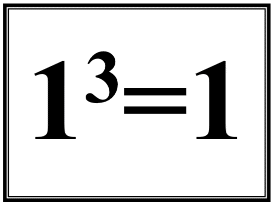
In the beginning God revealed Himself as the Father and Creator of the universe. And then, in the fullness of time, God revealed Himself as the eternal Logos, Son of the Father, who came to demonstrate the depth of God’s love for fallen humanity by dying as a propitiation for our sins and rising again. Finally, when the Church was formed on Pentecost some 50 days later, God revealed Himself as the purifying and sanctifying Holy Spirit who has come to convict the world of sin and to seal all of those with faith in Jesus Christ. God has progressively revealed Himself to mankind through the dispensations of time and this God whom we believe in can be known personally and relationally. We declare of Him that there is no other and none else deserving of worship, glory, and praise. It is from Him that we have learned the way of salvation, which is found only in His Son, Jesus Christ.
The “Shield of the Trinity” or Scutum Fidei was a diagram developed in medieval Europe as a visual aid to explain the doctrine of the Trinity and the relationship of the Persons within the Godhead:
CREATION
Having established that God alone is the self-existent being who transcends space and time, who made the cosmos by His power, we move on to the question of creation itself. How and when was it made? What was it made from?
“And Jehovah answers Job out of the whirlwind and says: ‘Who [is] this—darkening counsel, || By words without knowledge? Now gird your loins as a man, || And I ask you, and you cause Me to know. Where were you when I founded the earth? Declare, if you have known understanding. Who placed its measures—if you know? Or who has stretched out a line on it? On what have its sockets been sunk? Or who has cast its cornerstone—In the singing together of [the] stars of morning, || When all [the] sons of God shout for joy?’” (Job 38:1–7)
God Himself questions those who would question Him. In the 21st century, mankind prizes questioning authority, critiquing all truth claims, and speculating on what, other than God, might explain what we see, but God is self-evident (Ps. 10:4; 14:1; 53:1; Rom. 1:18–32; 1 Cor. 1:20) and the ultimate example of Occam’s razor in action. Modern sensibilities and speculation are incompatible with the thoughts of a God who was quite literally present to see the creation of the world—who laid its foundations Himself.
Every parent is intimately acquainted with the incalcitrant stage of childhood when the wiseacre is convinced that he or she knows more than them. The parent knows with genuine certainty that the child is self-deceived. Scripture tells us that this is how we behave toward God. He is the perfect parent who actually does know everything, but we continually question just about everything He says. It is like an ant questioning an astrophysicist, but the gulf is infinitely greater. When we ask these important questions about the origins of the universe, we must first ask who is more trustworthy: men, or God?
From the book of Genesis, we learn that the universe had a definitive beginning and God is the one who created it. It was not formed from preexisting matter, nor is it part of God, for God did not create Himself. God alone is immortal (1 Tim. 6:16). The biblical concept of creation is what has been termed creatio ex nihilo, which is Latin for “creation out of nothing.” Indeed, God is the only eternal and self-existent entity because He is the greatest conceivable being and the immutable, unmoved mover.
“In [the] beginning [time] God created the heavens [space] and the earth [matter], and the earth was formless and void, and darkness [was] on the face of the deep, and the Spirit of God [was] fluttering on the face of the waters, and God says, “Let light be” [energy]; and light is.” (Gen. 1:1–3)
Time, space, matter, and energy all began to exist. God never began to exist because He has always existed.
Side note #1: when you cross-reference John 1:1 (“in the beginning was the Word, and the Word was with God, and the Word was God . . .”) with Genesis 1:1–3, it is clear that all three Persons of the Godhead were intimately involved in creation. God (the Father) created the heavens and the earth (v. 1); the Holy Spirit was fluttering over the primordial sea (v. 2); and God the Son, the preincarnate Logos or “Word,” speaks things into existence (v. 3).
Side note #2: Genesis 1 explains that the universe had a clear beginning, while other passages, such as Isaiah 65:17–19, 2 Peter 3:10–13, and Revelation 21:1–5, explain that the present creation has a definitive end—to be replaced by a permanent “new heavens and new earth.”
IN SIX DAYS
We have answered how the universe was made and what it was made from, but now we move to the contentious question of when. Secular estimates suggest it came to be approximately 13.8 billion years ago. Many Christian scholars who adhere to a literal hermeneutic believe it is much younger and have been labeled “young earth creationists.” What does the Bible say, and can it withstand any sort of scrutiny?
To adequately answer this question, we must return to the earlier question asked: who is more trustworthy: men, or God? Remember that the Creator Himself questions those who would presume to know more than they really do and who would think it is logical to question Him—like the ant questioning the astrophysicist, or the child questioning an adult ten times his age. “Where were you when I founded the earth?”
“. . . for it has been written: ‘I will destroy the wisdom of the wise, and the intelligence of the intelligent I will bring to nothing’; where [is] the wise? Where the scribe? Where a disputer of this age? Did God not make foolish the wisdom of this world?” (1 Cor. 1:19–20)
The humble heart will acknowledge that the supreme, all-knowing, all-powerful, everywhere-present, necessarily-existent being is the One to go to for the answers. He has not remained hidden, but has revealed the answers in His word, the Bible. Scientists may be brilliant, but if they are searching for the solutions to these questions with pride, they are destined to find the wrong answers (Prov. 1:7; 11:2; 16:18; 18:12; Jas. 4:6).
The Bible emphatically and repeatedly states that the universe was created in six days (Gen. 2:2; Ex. 20:11; 31:17). And that is not just the earth, but the heavens and the sea as well (according to those passages). There have been clever attempts to circumvent this in order to reconcile the Bible to modern, secular estimations, but they run into exegetical trouble in great abundance.
In Genesis 1–2, not only are the days of creation numbered from one to six, but the phrase “and there is an evening, and there is a morning” is included for each and every day. Attempting to get around the crystal clear, prima facie teaching of Scripture involves the insertion of some unmentioned, ambiguous “gap” of time before, during, or between the days of Creation, or redefining the normative meaning of “day.” These allegorical hermeneutics are complicated workarounds with lots of moving parts and subjective assumptions. Rarely will two allegorists agree, since allegorism is often, by its very nature, a subjective exercise. The allegorists run headlong into the plain, normatively understood meaning of the text.
Not only does Scripture state that the universe was created in six days and that each of these days featured an evening and a morning, but Scripture subsequent to Genesis—from Exodus to the very end of the Bible—seems to treat the Genesis account as historical narrative rather than an allegorical literary feature. For instance, Jesus Himself proclaims that men and women were such since the beginning of creation (Mk. 10:6). If the universe was 13.8 billion years old, then His statement would be categorically false.
|
The First Day
|
God creates time (“in the beginning”), space (“the heavens”), matter (“the earth”), and energy (“light”). He separates the light from the darkness, creating, from the vantage point of earth, “day” and “night.”
|
|
The Second Day
|
God creates the firmament—“sky.”
|
|
The Third Day
|
God gathers the water under the sky and causes dry ground to appear, thus creating the land and the sea. He also creates vegetation.
|
|
The Fourth Day
|
God creates the sun, moon, and stars to serve as signs, to mark appointed times, and to give light on the earth.
|
|
The Fifth Day
|
God creates all the living creatures of the sky and sea.
|
|
The Sixth Day
|
God creates all the living creatures that dwell on land, including human beings, made in His image.
|
So how long ago did God fashion the world in six days? This question depends, at least in part, on which manuscripts of the Old Testament are authentic to the original text. The primary chronological distinctions are found in the Hebrew Masoretic Text (MT) and the Greek Septuagint (LXX). Most Bibles printed today use the MT as the basis for translation, although a sizable number use the LXX. The LXX is a translation from the 3rd and 2nd centuries BC, whereas the MT is more recent, although scholars tend to favor both as containing original readings in certain passages. The question is, which manuscript contains the correct ages found in Genesis 5 and 11? These two chapters provide a record from the first man Adam all the way to Abraham.
The MT chronology tells us that the universe was created approximately 6,000 years ago, whereas the chronology presented in the LXX suggests a creation date about 1,500 years prior to that. Based on the biblical text, we can determine that the earth is approximately 6,000 or 7,500 years old.
YOUNG OR OLD?
Though belief in a young earth is often thought to be a peculiarity of modern biblical literalism, it was actually the default view of the Church for most of its history, as well as the default view of Judaism and much of the rest of the ancient Near East. Times have certainly changed with the advent of Darwinism, uniformitarianism, and Old Earth Creationism, but these views are recent, largely dating from the 19th century—less than two hundred years ago.
Though these theories self-proclaim their verifiability through science, each of them has at its core two massive assumptions that make them shaky at best:
The first assumption is that observable phenomena are always best explained through other observable phenomena. In other words, natural things demand natural explanations. The result of this assumption is that things that have a genuinely supernatural explanation will always be misexplained and misidentified. To give an example: suppose the biblical account of Jesus turning water into wine at Cana is an event that actually occurred. And suppose a scientist armed with all his testing apparatus stumbled upon the jars of wine. And suppose also that this particular scientist demanded a natural explanation. What would his conclusion be? He would test the wine and tell you it came from such and such vineyard, and was some particular vintage, from some number of decades ago. His tests would prove it out, so to speak, but his conclusion would be completely false. Did his equipment lie to him? Did Jesus deceive him by creating aged wine? No, of course not. The scientist deceived himself with his assumptions, which precluded the supernatural.
The second assumption is that man, who was not present to witness the origin of many of the things he claims to understand, can reason out an explanation with the three pounds of knobby cerebrum behind his eyes. Remember what God has said: “I will destroy the wisdom of the wise, and the intelligence of the intelligent I will bring to nothing,” and, “Where were you when I founded the earth?” and also, “A fool has said in his heart, ‘There is no God . . .’”
And just as the cosmological, ontological, and teleological arguments, among others, demand the existence of a supreme, all-powerful God/Being/Entity, so the secular mind, try as it might, will never be able to outmaneuver the possibility of supernatural explanations. An all-powerful God can do what to mortal man is certifiably impossible (Lk. 1:37; Mt. 19:26).
Many young earth creationists have oddly boxed themselves in while attempting to counter those who by very definition are boxed in by naturalistic and humanistic assumptions. Some creationists have tried to prove a young earth through natural means, using the same kinds of arguments as those who reject the supernatural. That might work in some instances, but not in all.
In their effort to defend the truth of the Bible, have some of those who have defended the Bible’s earth age inadvertently overlooked some of the simple answers?
Many creationists have sought to show that all evidence points to a young earth. They have cleverly devised alternative interpretations of starlight data, Precambrian geology, ocean salinity, radiometric dating, and the fossil record, and some of these arguments are surprisingly strong, but the million-dollar question is this: does the earth appear old because it is that old, or because God made it old to begin with?
Is it heretical to think God may have created the universe a short time ago with the appearance of great age? Some would claim that if God did it that way, He would be deceptive, but was Jesus deceptive when He turned water into deliciously-aged wine? Or was Jesus deceptive in creating enough bread and fish—things that naturally take time to grow—to feed thousands? Was God deceptive in creating Adam, Eve, and the animals already grown? The Bible is full of examples of God creating things with the appearance of age, or doing things that cannot happen naturally. Creation itself was a miraculous, supernatural event, and a plain reading of the Genesis 1–2 account seems to confirm that God did create the universe with the appearance of age—with fully-formed earth and sea, sun, moon, and stars, sea creatures, birds, and land-dwelling animals.
Early on the sixth day, before Eve was even formed, God was already bringing fully-formed animals to Adam for him to name. Adam was old enough to walk, talk, and creatively name each of the different animal kinds. And later that same day he was old enough to declare of Eve, “This at last! Bone of my bone, and flesh of my flesh!” He was apparently old enough to marry her that same day, too (Gen. 2:23–25; cf. 3:8). Yet Adam had only existed in spacetime for less than a day.
Uniformitarians say that the universe looks old because it is old. Many creationists say the universe looks young because it is young. The Bible seems to say, quite plainly actually, that the universe looks old, at least by some measurements, because God made it old from the beginning. The Bible tells us that the universe was created some 6,000 or 7,500 years ago with the appearance of great age. That does not mean that everything points to an old earth in terms of appearance, but it does mean that the appearance of age in the universe is 1. compatible with the biblical account, 2. reconcilable with a young earth in actual age (thousands of years vs. millions of years), and 3. not an act of deception by God since the Bible plainly declares that is how He did it—the creative pattern and mechanism in Genesis 1–2 is similar to how God works miraculously and supernaturally throughout Scripture. And God will apparently create a new universe with the appearance of age in the future (Rev. 21; 2 Pt. 3:10–13).
When it comes to the young earth vs. old earth debate, it is best to step back and view the evidence collectively. And when you do, you see a picture that fits well with the biblical account of an old earth made recently, but it is a picture that is not easily explained by either of the other extremes. The table below shows evidence that points more toward a young earth (A), evidence that shows the appearance of an old earth (B), and evidence that cannot necessarily substantiate either (C).
|
Appears Young (A)
|
Appears Old (B)
|
Both/Either (C)
|
|
Helium diffusion from zircon1
|
Starlight5
|
Ice layers7
|
|
Polonium radiohalos
|
Radiometric dating8
|
|
Ocean salinity2
|
Stalactite and stalagmite formation9
|
|
Magnetic field decay rate3
|
Fossil accumulation6
|
Petroleum quantity and formation rate10
|
|
Moon drift rate4
|
Missing transitional species and fossil deposition11
|
|
Bent sedimentary rock layers without fracturing
|
Erosion
|
1. The rapid rate at which helium diffuses from rock, and the amount of helium remaining in ancient, Precambrian rocks like zircon, suggests that the earth is thousands, rather than billions, of years old. A number of uniformitarian rebuttals have been attempted to disprove this evidence, but they have not satisfactorily resolved the primary inconsistency with their view.
2. Calculating the rate of ocean salinity increase is another way to place a limiting factor on the earth’s age. The oceans are continually becoming saltier and saltier as rivers mix in sediment from the continents, rains wash sediments into the sea, and lava deposits even more salt content into the oceans. The ocean is so salty that if you were to take a one foot by one foot by one foot box, fill it with seawater, and let all the water evaporate away, you would be left with around one quart of salt. That is a lot of salt! There have been several critics of using this method as a limiting factor for earth age, but the critics all have one thing in common: they have yet to discover any method that removes more salt from the oceans than the oceans take in naturally. Even natural evaporation does not remove salt from the oceans. Runoff from rain brings more salt into the sea, but evaporation does not bring any salt back to the land—evaporation only removes H2O from the sea, not salt. And on top of that, tectonic movements only add to the salt content as well, as more and more lava flows bring salts up from the earth’s crust and mantle. Using this method, we can put an upper limiting factor on the age of the earth’s oceans at 62 million years—billions of years closer to the Bible’s estimate than the uniformitarian estimate.
3. The earth’s magnetic field decay rate is another example: the earth’s magnetic field is losing more energy than it takes in—and it is losing its energy at an exponential rate. As a matter of fact, the current magnetic field was twice as strong only 1,500 years ago. This rate places an upper limit on the age of the earth of approximately 8,700 years, prior to this time the field would have been too strong to support life.
4. The moon is pulling away from the earth at a constant rate. Since this rate is constant (about 1.5 inches per year), then we can extrapolate backward to find a point when the earth and moon were literally touching—an upper limit of about 1.5 billion years ago (only one-third of the supposed 4.5-billion-year age of the earth). The moon’s proximity to the earth would have killed off all life on our planet much more recently—the moon’s tidal effects grow exponentially more powerful as it gets closer to the earth. Only hundreds of millions of years ago the moon’s proximity would have caused a global flood literally every day, but over the course of 6,000 years the moon has only drifted about half of a mile!
5. As of yet, no evidence conclusively shows that the speed of light (186,000 mi/s) has changed over time (i.e., slowed down). This means that light from distant celestial objects does appear to have been travelling for millions or even billions of years.
6. There are fossil beds with such large quantities of deposited organisms that it is thought unlikely that they could have all been contemporary. Proponents of a young earth tend to explain these as accumulations resulting from water currents during the Flood and also evidence for huge pre-Flood populations.
7. There are ice sheets with hundreds of thousands of layers, however, layers can be deposited many times per year. The uniformitarian view tends to view layers as representing annual accumulations, but this is not the span of time over which layers naturally form. For example, crashed aircraft from World War II have been found under 300 feet of ice, representing many hundreds of individual layers. Even secular glaciologists have abandoned the previous dogmatism, recognizing that layers can be formed much more often than annually, and the deeper one looks for ice core samples, it becomes a much more difficult and subjective exercise determining where one layer ends and the next one begins.
8. Radiometric/radioisotope dating often suggests rocks are hundreds of millions of years old, however, different tests on the same sample often result in estimates separated by literally hundreds of millions of years. Additionally, test results from rocks formed only decades ago often show up as being several million years old.
9. Stalactites and stalagmites are commonly said to form over hundreds of thousands of years, but under the right conditions they can actually form very rapidly—within years. In fact, they are frequently found under overpasses and bridges, and hanging from manmade concrete structures.
10. The quantity and origin of hydrocarbons is thought by many to suggest long geological ages, however, like stalactites and stalagmites, under the right conditions they have been shown to form rapidly. Also, the secular view that the bulk of petroleum has an organic origin has increasingly come under pressure as evidence shows that many deposits cannot be explained organically.
11. The original theory of evolution by natural selection predicted the discovery of a very large number of transitional species in the fossil record to account for the present variation seen. Around the time of Darwin’s On the Origin of Species, he assumed that as science advanced we would find an “inconceivably great” number of “missing” transitional fossils and his theory would be validated, but as he grew older and few if any of the “missing links” were found, he grew increasingly disturbed by and skeptical of his own theory.
Here are the numbers: 250,000 and 0. 250,000 is the approximate number of species we have found in the fossil record (a number which constitutes tens of millions of independent specimens). 0 is the number of transitional fossils universally agreed upon as transitional by proponents of Darwinian evolution. And one more number just for kicks: 2,000,000,000 (two billion with a ‘b’). That is a low-end estimate of the number of species we should have found in the fossil record to accommodate the 250,000 niche species already found and catalogued. Because of this overwhelming lack of evidence for macro-evolution, paleontologists have proposed what is called Punctuated Equilibrium. Their theory posits that since no conclusive transitional species have been catalogued, they must have all “transitioned” really quickly over “punctuated” periods of time and not made it into the record. In other words, on the face of it the fossil record looks more like a snapshot confirming the biblical account—evidence for unique animal species and kinds, rather than a “tree of life” with abundant evidence of transitional linkage.
Even some of the classic examples of “missing links” are now understood to either be misclassified or outright frauds. An example of a misclassification would be archaeopteryx, which is now generally regarded as a regular perching bird (with some peculiar features). Examples of outright fraud would be Lucy, Nebraska man, and Piltdown man. Furthermore, soft tissues have now been found from several dinosaur species, including tyrannosaurus, triceratops, iguanodon, and gorgosaurus—animals that were supposed to have died out over 64 million years ago.
The absence of transitional fossils does not attest to the age of the earth by itself, but it does appear to poke a big hole in the predominant uniformitarian view of macro-evolution.
In terms of fossil deposition itself, both sides have theories to explain what we see. Fossil accumulation quantity might favor an old earth perspective, whereas the absence of transitional species and the appearance of sudden speciation (e.g., the Cambrian explosion) and catastrophism (e.g., animals fossilized whole, fossilized while eating or in combat, polystrate fossils, etc) tend to favor the young earth view.
IS THE EARTH FLAT?
A debate that has resurfaced in a big way in recent years regards whether or not the earth is flat. While proponents of a flat earth come from a variety of religious backgrounds, many have used the Bible in an attempt to defend their view, suggesting that a literal interpretation of Scripture necessarily causes one to believe in a flat earth. However, the flat earth view is not necessary with a literal hermeneutic, nor does it withstand scientific scrutiny. Here are the reasons:
1. The Bible does not actually state that the earth is flat. This is a huge, gaping hole in the argument that a literal interpretation of Scripture necessitates a flat earth. Without such direct scriptural evidence, flat-earth proponents are left with interpreting certain figurative passages of Scripture in such a way as suits their theory. Passages that are emphasized include those that speak of the earth having four corners (e.g., Isa. 11:12; Rev. 7:1; 20:8), being set on pillars (e.g., 1 Sam. 2:8), and being unmoved (e.g., Ps. 104:5).
The problem with their view is that the Bible also speaks of the earth as a circle (Isa. 40:22; cf. Prov. 8:27). A circle does not have corners. And a circle is the shape that a sphere appears from any single vantage point. In addition, the biblical words for “earth” and “land” are the same. The land of planet earth does have corners, such as the extremities of continents and so forth.
In regard to the passages that speak of pillars, or the earth not being moved, we also have passages that say the earth is suspended over nothing (Job. 26:7) and does move (Isa. 24:20; Nah. 1:5; Heb. 12:25–29). Thus, we can reconcile the full counsel of Scripture in that the planet itself is not moved from its stable course and orbit, and the land of the earth is not moved from the vantage point of an earth dweller. The pillars of the earth are a figurative symbol, but if taken literally, perhaps a description of the natural structures that undergird the surface of the land since the earth is not actually hollow.
2. Other celestial objects appear to be spheres, including the sun, moon, planets, and stars. They are not just simple lights in the sky. And in fact, we can observe many of these objects rotate on their axes.
3. The earth casts a circular shadow on the moon.
4. Objects over the horizon do not suddenly pop into view but appear to emerge from below the horizon because of the earth’s curvature.
5. Even with no obstacles, an observer at ground level cannot see the same distance as an observer higher than him. This is because the earth is round. If it was flat, then an observer at ground level would see the same distance as an observer who is miles up in the air.
6. The argument of a mass, coordinated deception of evidence is necessary to defend the flat earth view. There is substantial, observable proof that the earth is a sphere: circumnavigation via aircraft, circumnavigation via ship, pictures taken from thousands of satellites and spacecraft, hundreds of thousands of eyewitness testimonies, and so forth.

THE CREATION OF HEAVENLY BEINGS
Genesis clearly explains the timing of the creation of things we can see and experience from here on earth, such as the sun, moon, and stars, the land and the sea, and the flora and fauna of our planet, but what about angels and other creatures in the heavenly realms? The Bible is clear that life is not for earth alone, but it also exists in the heavens.
“He who is sitting on the circle of the earth, || And its inhabitants [are] as grasshoppers, || He who is stretching out the heavens as a thin thing, || And spreads them as a tent to dwell in.” (Isa. 40:22)
“And suddenly there came with the messenger a multitude of the heavenly host, praising God, and saying, ‘Glory in the highest to God, and on earth peace, among men—good will!’” (Lk. 2:13–14)
When were these heavenly creatures created?
The Bible does not tell us explicitly as it does with the creation of our own world, but we can probably deduce a relatively clear answer. As has been laid out through the plain teaching of Scripture, God not only made the earth in six days, but He also made the heavens in that same period of time. The first day of creation involved the creation of time, space, matter, and energy. To be created “before” time began, so to speak, is thought to be a logical inconsistency since things happen within time. Creation is an action. Actions take time to occur. They transpire. In this sense, God’s initial creative actions coincided with the creation of time itself.
If the heavens themselves were created “in the beginning” then we can conclude that those creatures who dwell in them were not created before they had a place to be placed! Genesis 1–2 and the other confirming passages (e.g., Ex. 20:11; 31:17) tell us the heavens are a created thing just as the earth is. God alone is eternal and transcendent to time and space. Heaven and angels are not. Created things can be everlasting—meaning that they can endure forever if God so chooses. But created things can never properly be eternal—meaning without beginning or end. God alone is eternal, so we can conclude that the heavenly beings, like angels, were created sometime during the six days of creation. And Job chapter 38 appears to tell us on which day they were created:
“Where were you when I founded the earth? . . . Or who has cast its cornerstone—In the singing together of [the] stars of morning, || When all [the] sons of God shout for joy?” (Job 38:4, 6b–7)
This account features God questioning Job about creation. God was there at creation and is the only accurate source for information about what transpired. He tells Job that when He founded the earth “stars of morning,” the “sons of God,” sang and shouted for joy. The luminaries of the sky—sun, moon, and stars—are inanimate objects that do not sing, so these “stars” here refer to something besides Polaris, Spica, or Sirius. The Bible routinely uses “stars” as a symbolic term for angels (e.g., Rev. 1:20; 12:3–4, 7–9). And the account in Job drives the point home by directly paralleling the “stars of morning” with the “sons of God” (transliterated bene Elohim from Hebrew), which is another term used for angels (e.g., Job 1:6; Gen. 6:4). The angels were alive and singing when the earth was created, and the earth was created on the first day according to Genesis 1. The chronology in the first verse of Genesis even accords with this view: “In [the] beginning God created 1. the heavens and 2. the earth . . .”
We could conjecture an order of events on the first day of creation as follows: 1. God creates time and space (“the heavens”), 2. God creates the heavenly creatures (e.g., angels), 3. God creates the earth, 4. God creates light, and 5. God separates the light from the darkness.
Alternatively, if the founding of the earth in Job 38 has the narrower meaning of the appearance of dry land—“earth” and “land” in Genesis 1 and Job 38 being the same word in Hebrew—then the angels may have been created on the second day of creation or on the third day of creation prior to the appearance of dry land.
In conclusion, we can determine from Scripture that the sentient stars—the heavenly beings—were created on the first, second, or third day of creation, whereas the inanimate stars, which serve as lights and signs for the earth, were explicitly created on the fourth day.
“For the scientist who has lived by his faith in the power of reason, the story ends like a bad dream. He has scaled the mountains of ignorance, he is about to conquer the highest peak; as he pulls himself over the final rock, he is greeted by a band of theologians who have been sitting there for centuries.”
― Robert Jastrow, God and the Astronomers
“We need intimate knowledge of the past. Not that the past has any magic about it, but because we cannot study the future, and yet need something to set against the present, to remind us that the basic assumptions have been quite different in different periods and that much which seems certain to the uneducated is merely temporary fashion. A man who has lived in many places is not likely to be deceived by the local errors of his native village: the scholar has lived in many times and is therefore in some degree immune from the great cataract of nonsense that pours from the press and the microphone of his own age.”
― C.S. Lewis, The Weight of Glory
“All that we call human history—money, poverty, ambition, war, prostitution, classes, empires, slavery—[is] the long terrible story of man trying to find something other than God which will make him happy.”
― C.S. Lewis, Mere Christianity
“Remember former things of old, || For I [am] Mighty, and there is none else, || God—and there is none like Me. Declaring the latter end from the beginning, || And from of old that which has not been done, || Saying, My counsel stands, || And all My delight I do.”
— The Creator (Isa. 46:9–10, LSV)